Skip to content

Open-source AI agent platform for enterprise documents

DocsGPT is an open-source (MIT) AI agent platform for enterprise documents, built by Arc53. It connects an organisation's files and systems to private AI assistants, agents and workflows with cited answers, and runs in the cloud, on your own servers or fully air-gapped.

DocsGPT 1.0.0 · MIT · github.com/arc53/DocsGPT ↗ · What's new ↗

Last updated:

docsgpt — product tour

What DocsGPT does

Documents go in; cited answers and governed actions come out.

  1. 01

    Knowledge

    30+ file formats with OCR for scans, websites, wikis your agents can edit and knowledge graphs; every answer cites its passage. Knowledge →

    pdf · docx · xlsx · pptx · md · html · png · mp3

  2. 02

    Connectors

    Google Drive, SharePoint, Confluence, GitHub, Notion, Linear and any MCP server: sync into Knowledge, give agents tools, or both. Connectors →

    sync · agent tools · allow · ask first · off

  3. 03

    Search

    Cited answers with a citation reader, hybrid BM25 + vector and GraphRAG, testable before anyone relies on it. Search & Retrieval →

    classic · hybrid · graphrag · citations: title · source · page

  4. 04

    Agents

    Classic, Agentic, Research and Workflow agents with built-in and connected tools, schedules and team sharing. Agents →

    tools · schedules · teams · api key

  5. 05

    Workflows & artifacts

    No-code builder with If / Else branches, code and shared state; DOCX, PPTX, XLSX and PDF outputs. Workflows → · Artifacts →

    start · ai agent · set state · if / else · code · end

  6. 06

    Channels

    OpenAI-compatible API, an MCP server for Claude and Cursor, chat and search widgets, Slack, Telegram and Discord bots. API, MCP & Widgets →

    /v1/chat/completions · /mcp · widget · slack · telegram

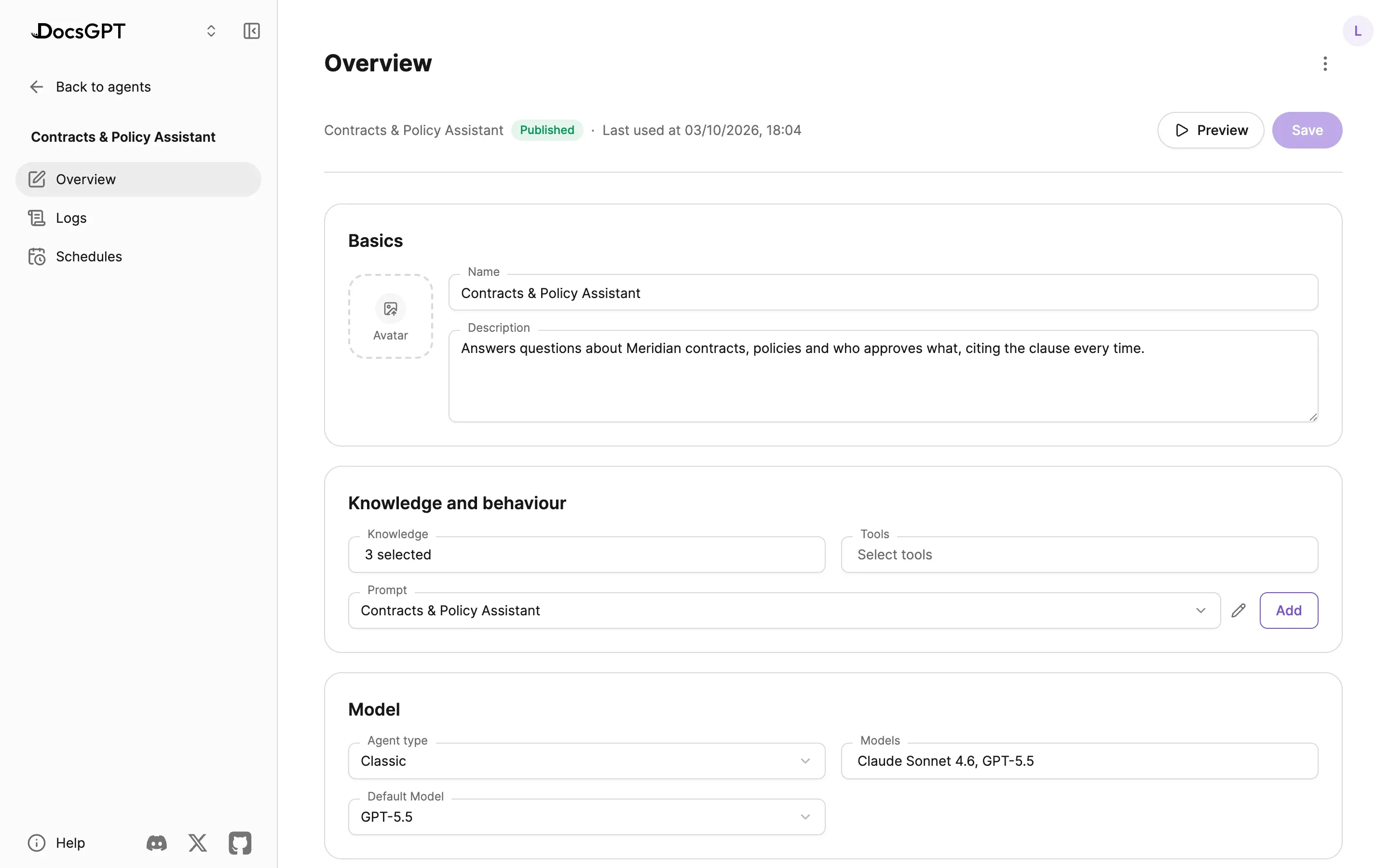
app.docsgpt.cloud — Agents › Overview
The agent editor's Overview for a published Contracts & Policy Assistant: Basics with name and description, Knowledge and behaviour with three knowledge sources, tools and a prompt, and Model with the agent type, the models offered and a default model.
app.docsgpt.cloud — Agents › Overview
The agent editor's Overview for a published Contracts & Policy Assistant: Basics with name and description, Knowledge and behaviour with three knowledge sources, tools and a prompt, and Model with the agent type, the models offered and a default model.
Workflow builder
  1. startStartchat · api · webhook · schedule
  2. ai agentClassifysmall model
  3. ai agentExtractwrites state
  4. if / elseDecideon shared state
  5. endNotifytemplate
humanHuman approvalapprove · reject · logged
Text version

1. Start (chat · api · webhook · schedule) → 2. Classify (small model) → 3. Extract (writes state) → 4. Decide (on shared state) → 5. Notify (template). Branch from Decide: else · confidence < 0.8 → Human approval → Notify.

Governed by design

Guardrails check content at four intervention points under a company-wide floor; human approval can hold any answer or tool call; admins govern connectors, roles and quotas; identity comes from your IdP over OIDC and SCIM 2.0; every sign-in, change and guardrail decision lands in one exportable Activity feed; every run leaves a trace.

 Where it actsPage
GuardrailsUser input, retrieved sources, tool results and the final answer: 4 intervention points, 7 checks, and a company-wide floor no agent can weakenGuardrails →
Human approvalAny chat answer or tool call held for one-click review; changes through connected services ask firstHuman-in-the-loop →
Connector governanceAdmins choose which connectors members may use, whose account shared tools run with, and whether agents may writeConnectors →
SSO and SCIMSign-in with your identity provider; accounts created and removed by your directoryAdmin →
Roles and sharingInstance and team roles; Viewer or Editor on every agent, knowledge source, prompt and toolAdmin →
Activity feedOne append-only timeline of sign-ins, changes and guardrail decisions, exported as CSV or NDJSONActivity →
Usage quotasToken and spend limits per user, with team and instance defaultsQuotas →
TracesEvery run as a step-by-step trace, exported to Langfuse, Datadog, Grafana or any OpenTelemetry backendTraces →
Access tokensScoped, expiring tokens for scripts, the CLI and CI pipelinesAPI →
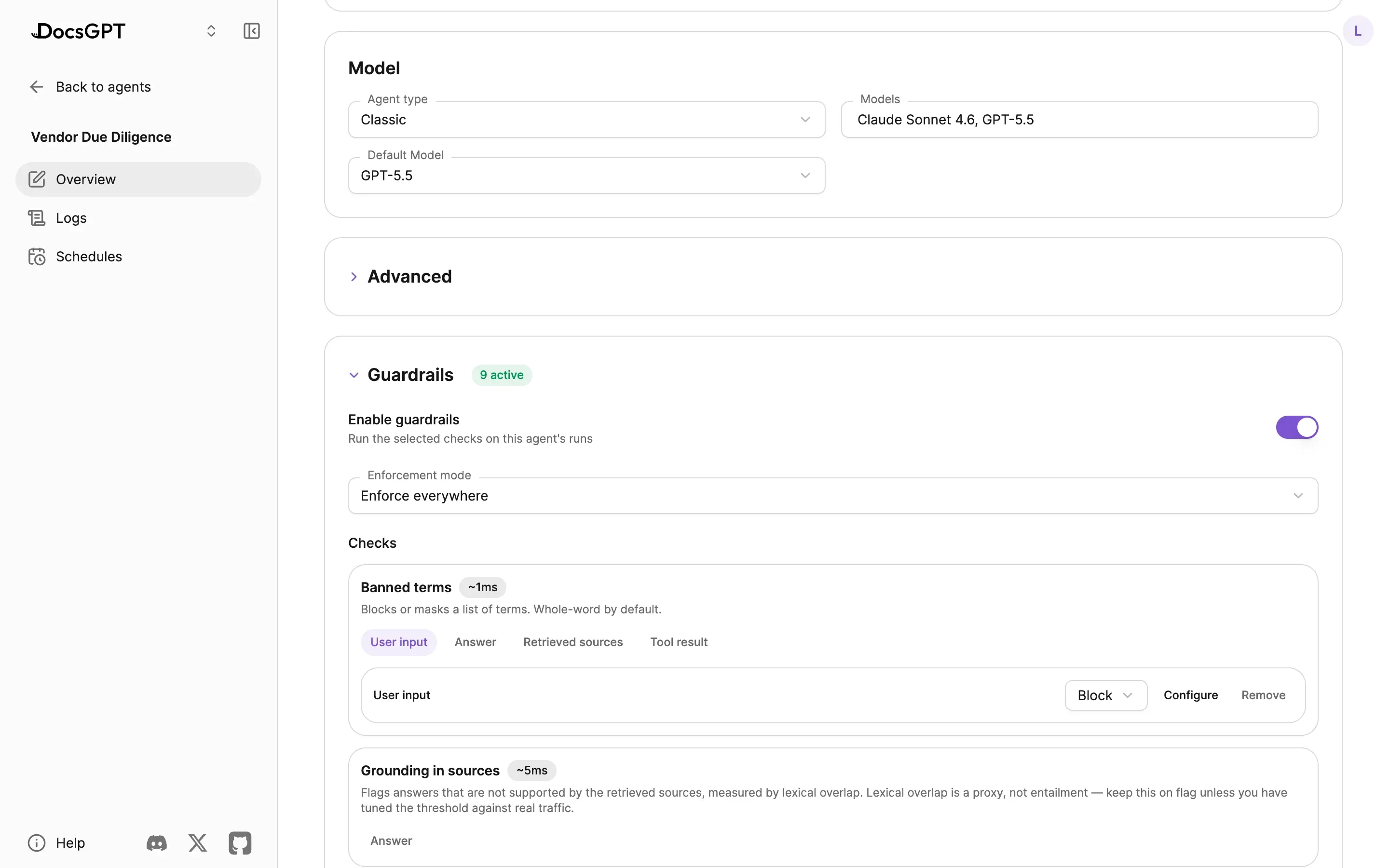
app.docsgpt.cloud — Agent › Guardrails
An agent's guardrail settings: guardrails enabled with 9 active checks, Enforcement mode set to Enforce everywhere, and checks such as Banned terms blocking at user input and Grounding in sources on the answer, each with its stages and action.
app.docsgpt.cloud — Agent › Guardrails
An agent's guardrail settings: guardrails enabled with 9 active checks, Enforcement mode set to Enforce everywhere, and checks such as Banned terms blocking at user input and Grounding in sources on the answer, each with its stages and action.
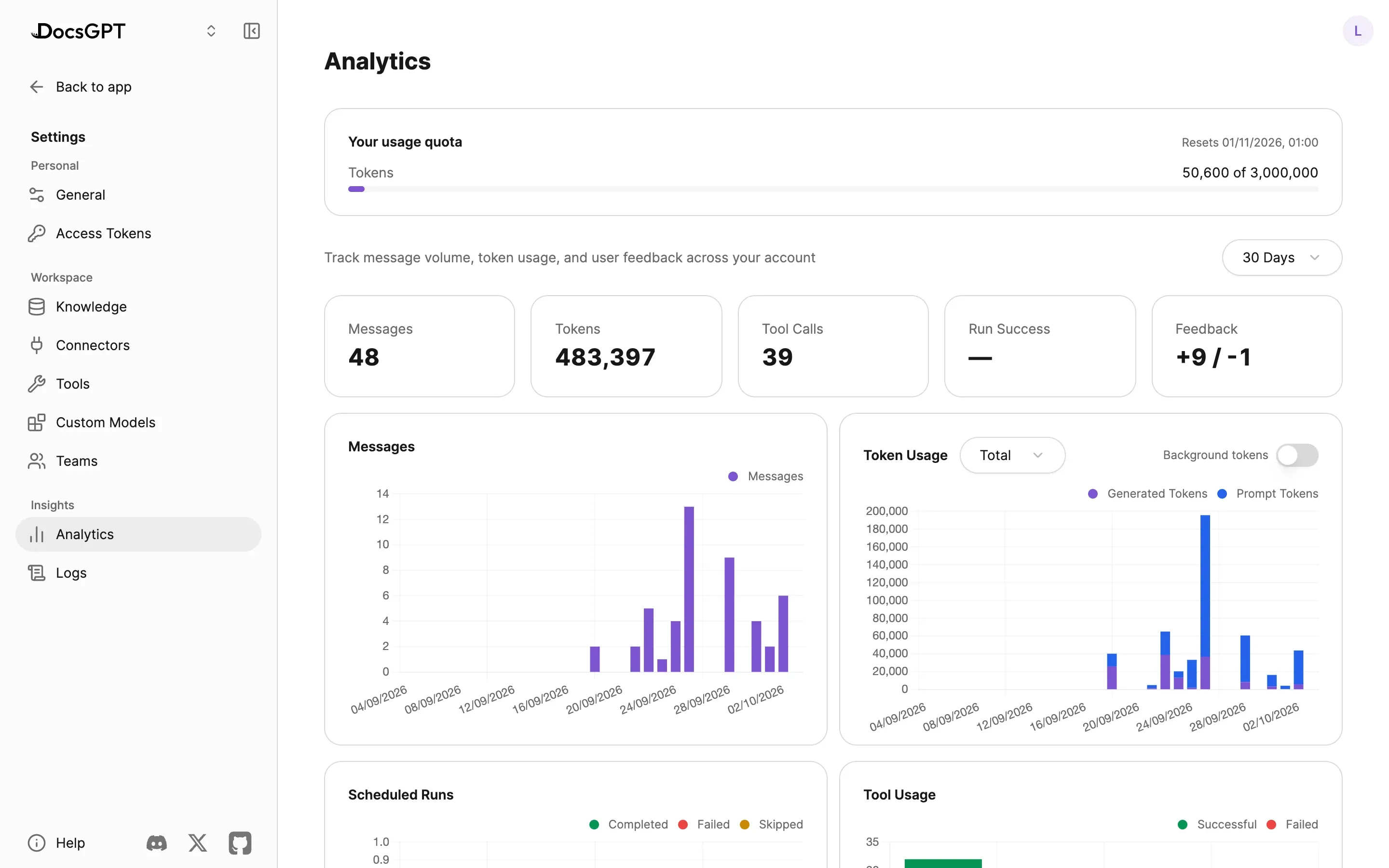
app.docsgpt.cloud — Analytics
Analytics over 30 days: a usage-quota bar, then messages, tokens, tool calls, run success and feedback, with charts of messages and token usage.
app.docsgpt.cloud — Analytics
Analytics over 30 days: a usage-quota bar, then messages, tokens, tool calls, run success and feedback, with charts of messages and token usage.

Runs where your data is

Cloud and Managed are operated by Arc53 and use an external network. On-premises is operated by the customer with egress optional (a hybrid on-prem platform with a cloud LLM is on-premises, not air-gapped). Air-gapped is operated by the customer with no external network at all.

 Who operates itExternal networkDetails
CloudArc53, multi-tenantYesCloud deployment →
ManagedArc53, dedicated instanceYesManaged deployment →
On-premisesCustomer, with Arc53 supportOptionalOn-premises deployment →
Air-gappedCustomer, with Arc53 supportNoneAir-gapped deployment →

The same platform, from one seat on every posture. Only the operator and the network boundary change. Compare deployment options →

Open source, model-agnostic

MIT licence, a public repository and no model lock-in: cloud providers and local engines, picked per chat or per agent.

DocsGPT is released under the MIT licence at github.com/arc53/DocsGPT. It runs on cloud providers or on local engines such as Ollama, vLLM and llama.cpp, and stores vectors in any of six vector stores, so the stack can be swapped without rewriting the application.

ollama · vllm · llama.cpp · faiss · pgvector · qdrant · milvus · elasticsearch · mongodb atlas

GitHub stars

18,317

on GitHub

Contributors

239+

Licence

MIT

Vector stores

6

Used by people from

  • AMD
  • Microsoft
  • Siemens
  • Deloitte
  • AstraZeneca
  • PwC
  • HM Government
  • Accenture
  • Payoneer
  • Intel
  • Airbnb
  • Amazon
  • Stanford
  • MIT

Example

24 h → 16 min

A large Central European commercial bank processes 10,000+ inbound documents a day; time-to-action fell from 24 hours to 16 minutes, with over 99.5 % classification accuracy, running fully air-gapped on the bank's existing NVIDIA T4 GPUs.

Source: EU bank, name under NDA

Product areas

Knowledge

Uploads, links, crawler, wiki; 30+ formats, OCR, chunking

/product/knowledge

Agents

Classic, Agentic, Research and Workflow agents

/product/agents

Workflows

Visual builder with conditions, code and state

/product/workflows

Connectors

Drive, SharePoint, Confluence, GitHub, MCP; sync and agent tools

/product/connectors

Models & BYOM

Cloud providers, local engines, Custom Models, fallback

/product/models

API, MCP & Widgets

OpenAI-compatible API, MCP server, chat and search widgets, bots

/product/integrations

CLI

Chat, local tools, agents as code, bench

/product/cli
Frequently asked questions

What is DocsGPT?

DocsGPT is an open-source platform for private AI agents, assistants and enterprise search over an organisation's own documents, built by Arc53 and deployable in the cloud, on your own servers or fully air-gapped. Every answer cites the title, source and page it came from.

Is DocsGPT free and open source?

Yes. The platform is MIT-licensed and can be self-hosted at no cost. Cloud seats, Managed instances and Enterprise (on-premises and air-gapped) deployments are paid; see pricing.

Can DocsGPT run on-premise or air-gapped?

Yes. With a local LLM, local embeddings and a self-hosted vector store, the whole stack runs inside your network with no external egress. See air-gapped deployment.

Does DocsGPT cite its sources?

Yes. Every answer carries the title, source and page number of the passages it used; click a citation to read the exact passage, then open the file in Knowledge.

Which LLMs does DocsGPT support?

Cloud providers (OpenAI, Anthropic, Google Gemini, Azure OpenAI, DeepSeek, Qwen, GLM and others) and local engines (Ollama, vLLM, llama.cpp and others). Pick the model per chat or per agent, and add your own endpoints as Custom Models. See Models & BYOM.

See DocsGPT on your documents

A 30-minute demo on your use case, or a free on-premises review with an engineer.